
Due to the significant rise of digital media in the world and its constant evolution, parents have to take note of how digital media would affect their young children, and how it would influence their developmental skills, their creativity, and their interactions around them. According to a study of the Canadian Paediatric Society, an age-appropriate and well-designed children’s program with specific educational goals can provide an early language and literacy development for the children beginning at about 2 years of age. They have found that interactive media that involves an adult can help children retain taught information, and they have concluded that these actions could teach the 2-year-old child due to the parent’s responsiveness and the age-appropriate digital content. Although children at 2 years of age are unable to properly learn from a TV screen, Canadian Paediatric Society had also stated that children are able to learn more intensively through face-to-face interactions with either parents or caregivers.
Meanwhile, a blog from Carepoint Academy informs the importance of storytelling to children. Through storytelling, it would help promote the child’s cognitive growth and development. The blog emphasized that storytelling helps children be taught moral values, be introduced to new ideas, promote a more creative way of thinking, help in developing their language skills, build up emotional intelligence, foster the child to have a love of reading, as well as making things more fun for the children to engage with. According to the blog, developing a child’s moral values helps them be able to develop a good sense of empathy for other people, and be able to learn on how to properly resolve conflicts effectively.
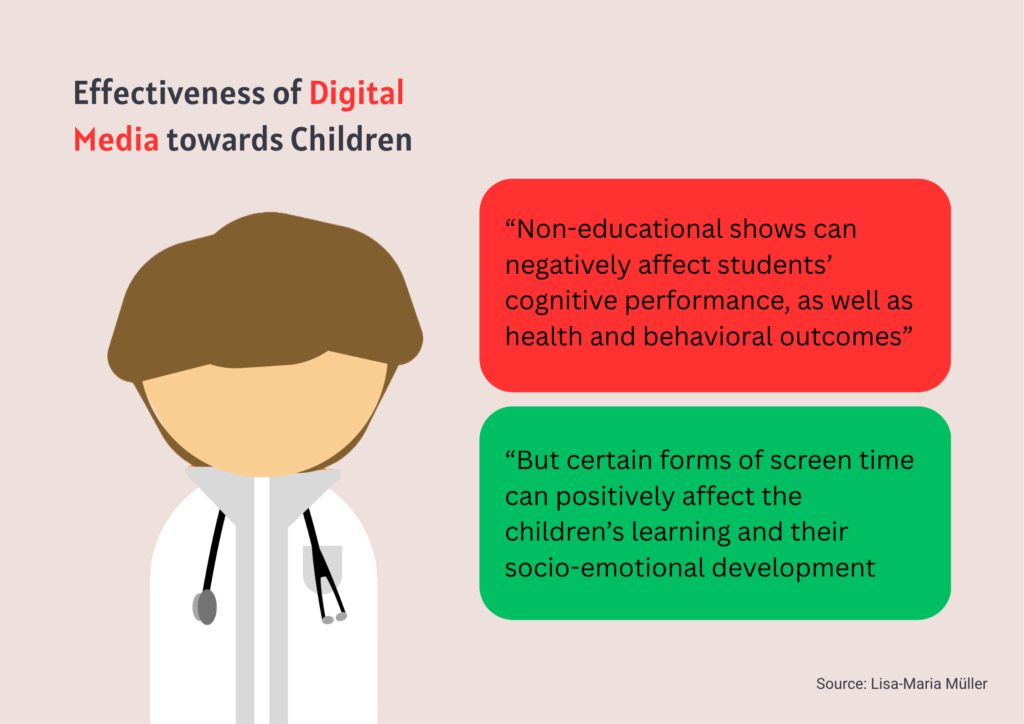
In a research review written by Lisa-Maria Müller, she found some studies that establish that prolonged exposure to non-educational television shows can negatively affect students’ cognitive performance, as well as health and behavioral outcomes (Cox et al., 2012; Stiglic and Viner, 2019; Tomopoulous et al., 2007, 2010; Walsh et al., 2020). But she had also found studies that had seen positive effects from certain forms of screen time that affects the children’s learning and their socio-emotional development, as well as language development. The examples of educational media that had a positive impact to children were Sesame Street and Blue’s Clues (e.g. Anderson, 2000; Kearney and Levine, 2019; Mares and Pan, 2013; Richards and Calvert, 2017; Madigan et al., 2020).
While there are risks associated with sedentary and non-educational screen time, it is important to acknowledge that the effectiveness of children’s digital media will differ depending on their purpose and function. It is important to consider the nature and quality of the given media, rather than simply giving young children an amount of time spending in front of screens, TVs or tablets. Educational apps should be chosen carefully, and co-viewing or co-interacting educational programs or apps further positively impacts a child’s development. There are a lot of children’s content in digital media, and there is no lack of it in the storytelling scene. With such easy access to stories through digital media, it would help teach children essential skills such as having a better grasp of emotional language or have an early language or literacy development.
SOURCES:
- https://www.google.com/url?q=https://pmc.ncbi.nlm.nih.gov/articles/PMC5823000/&sa=D&source=docs&ust=1775208380530917&usg=AOvVaw0FeoGDpWFsTmOHOM0e8JEO
- https://www.carepointeacademy.com/blog/posts/benefits-of-storytelling-for-kids
- Cox R, Skouteris H, Rutherford L et al. (2012) Television viewing, television content, food intake, physical activity and body mass index: a cross-sectional study of preschool children aged 2-6 years. Health Promotion Journal of Australia 23(1): 58–62.
- Stiglic N and Viner RM (2019) Effects of screentime on the health and well-being of children and adolescents: a systematic review of reviews. British Medical Journal Open 9(1):e023191.
- Tomopoulos S, Dreyer BP, Valdez P et al. (2007) Media content and externalizing behaviors in Latino toddlers. Ambulatory Pediatrics 7(3): 232–238.
- Tomopoulos S, Dreyer BP, Berkule S, et al. (2010) Infant media exposure and toddler development. Archives of Pediatrics and Adolescent Medicine 164(12): 1105–1111.
- Walsh J, Barnes J, Tremblay M et al. (2020) Associations between duration and type of electronic screen use and cognition in US children. Computers in Human Behavior 108. DOI: 10.1016/j.chb.2020.106312.
- Anderson DR, Bryant J, Wilder A et al. (2000) Researching Blue’s Clues: viewing behavior and impact. Media Psychology 2(2):179–194.
- Kearney MS and Levine PB (2019) Early childhood education by television: lessons from Sesame Street. American Economics Journal: Applied Economics 11(1): 318–50.
- Mares M-L and Pan Z (2013) Effects of Sesame Street: A meta-analysis of children’s learning in 15 countries. Journal of Applied Developmental Psychology 34(3): 140–51.
- Richards MN, Calvert SL (2017) Media characters, parasocial relationships, and the social aspects of children’s learning across media platforms. In: Barr R and Linebarger D (eds) Media Exposure During Infancy and Early Childhood. Berlin: Springer, pp. 141–63.
- Madigan S, McArthur BA, Anhorn C et al. (2020) Associations between screen use and child language skills: A systematic review and meta-analysis. JAMA pediatrics, 174(7): 665–675.


